







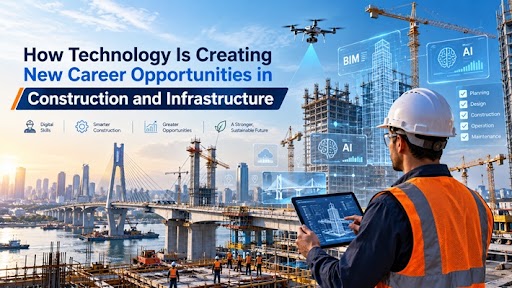
How Technology Is Creating New Career Opportunities in Construction and Infrastructure
- Concrete Cost Estimator
- Concrete Continuous Footing
- Landscape Bidding and Estimating
- Construction Cost Estimating
- Concrete and steel cost estimation
- Construction Cost Estimate Breakdown
- Construction Estimating Worksheet
- Home Construction Cost Estimate
- Estimate Pricing Sheet
- Sheet for General Contractor
- Construction Cost Estimate
- Labor Materials Cost Estimator
- Masonry Estimating Sheet
- Sheet for Building Contractor
- Construction Schedule Bar chart
- General Cost Estimator Sheet
- General Construction Estimate
- Building and Road Estimating Sheet
- Detailed expense estimates
- Door and Window Takeoff Sheet
- General Construction Cost Estimating Sheet

Key Takeaways
- BIM is transforming construction: It improves design coordination and project planning.
- AI and automation are creating new roles: These technologies support productivity and site safety.
- Data analytics improves project management: It helps predict delays and manage risks.
- Sustainable construction is growing: It increases demand for green building and energy efficiency experts.
- Drones improve site monitoring: They support surveying, inspections and progress tracking.
- Technical skills matter: BIM, AI, data analysis and relevant certifications help professionals prepare for emerging careers.
- Engineering and digital expertise create opportunities: Combining both skill sets helps professionals adapt to changing infrastructure needs.
Technology is transforming construction from a labour-intensive industry into a high-tech sector. Innovations such as Building Information Modelling (BIM), AI-powered analytics and robotics are creating well-paid jobs for data scientists, drone pilots and sustainability experts. These developments are opening up secure, future-ready career paths for people with strong technological skills.
The Digital Blueprint: Building Information Modelling (BIM)
Building Information Modelling (BIM) is the foundation of modern construction careers. Unlike traditional 2D blueprints, BIM is a highly collaborative process that enables architects, engineers and contractors to create a 3D digital model of a building before a single brick is laid. According to Maze CS, this technology plays a key role in reshaping construction careers.
What Is BIM?
BIM is a digital toolkit used to manage data throughout a project. It includes not only geometry but also spatial relationships, geographical information, and the quantities and properties of building components.
Why Is BIM Important?
BIM reduces costly rework by identifying design clashes, such as a pipe running through a steel beam, in a virtual environment. This saves millions of dollars and thousands of hours on major infrastructure projects. For professionals, it means moving from the construction site into an advanced digital environment where problems are solved through real-time simulations.
New Career Paths in BIM
- BIM Manager: Oversees digital workflows and ensures that all stakeholders use the same data standards.
- Digital Twin Specialist: Creates a dynamic digital model of a physical asset, such as a building, to monitor its performance long after construction is complete.
- VDC (Virtual Design and Construction) Coordinator: Uses BIM models to plan construction sequences and improve scheduling and logistics.
Also Read : How Modern Construction Techniques Are Shaping the Industry
Automation and Robotics: The New Workforce
Construction sites are increasingly home to more than just workers in hard hats. Robotics and automation are taking on repetitive, high-risk tasks, creating demand for professionals who can program, maintain and manage these machines.
What Is It?
This includes everything from autonomous excavators and bricklaying robots to 3D concrete printers. It also covers wearable technology, such as exoskeletons, that helps workers lift heavy loads without physical strain.
Also Read : AI in Structural Engineering - Work Faster, Design Smarter
Why Does It Matter?
Automation addresses the industry’s long-standing labour shortage while significantly improving safety. As noted by Liberty Mutual, technology plays an important role in reducing workplace injuries and managing the risks associated with modern infrastructure projects.
How to Enter This Field
Aspiring professionals should focus on mechanical engineering, robotics and software development. Understanding how hardware operates and how it addresses site-specific challenges is essential. Roles such as Robotics Technician and Automation Integration Lead are becoming more common in large contracting firms.
Data Science and AI: Predicting Project Success
The construction industry has traditionally seen relatively low levels of digitalisation, but the “big data” revolution has finally arrived. Artificial Intelligence (AI) and machine learning are now being used to predict project delays, manage supply chains and improve safety on construction sites.
What Is It?
AI in construction involves using algorithms to analyse historical project data and predict future outcomes. This includes predictive maintenance for machinery, which helps identify potential equipment failures in advance, and AI-powered computer vision, which uses cameras to monitor activities and progress on construction sites.
Why Is It Important?
Infrastructure projects often exceed their planned budgets. AI helps project managers identify risks before they become serious problems, helping large public infrastructure projects stay on track. This data-driven approach is also transforming the traditional role of a project manager into a more analytical and data-focused position.
Career Opportunities
- Construction Data Analyst: Analyses site data to improve efficiency and reduce waste.
- AI Implementation Manager: Oversees the implementation of machine learning tools across different construction sites.
- Predictive Risk Manager: Uses data to anticipate financial and safety risks before they occur.
The Growing Trend of Sustainable Infrastructure Careers
As the world moves towards “net zero,” the construction industry is at the forefront of the green transition. This shift has created strong demand for professionals who understand green building materials and energy-efficient design. Geeta University notes that modern civil engineering is increasingly focused on smart cities and sustainable development.
What Is It?
Sustainable construction involves using materials with a lower carbon footprint, such as cross-laminated timber and recycled steel. It also includes designing buildings that produce as much energy as they consume.
Why Is It Important?
Buildings account for a significant share of global carbon emissions. The industry needs a new generation of experts who can redesign infrastructure to withstand the effects of climate change while reducing its environmental impact.
New Career Roles
- Sustainability Consultant: Advises companies on how to meet green building certification standards such as LEED or BREEAM.
- Energy Auditor: Uses thermal imaging and IoT sensors to analyse the energy efficiency of buildings.
- Smart City Planner: Integrates IoT technologies into urban infrastructure to improve the management of traffic, waste and energy consumption.
Traditional vs. Tech-Driven Construction Roles
| Feature | Traditional Construction Role | Tech-Driven Construction Role |
|---|---|---|
| Primary Tool | Physical blueprints and hand tools | BIM software, tablets and VR/AR |
| Work Environment | Primarily on-site, exposed to elements | Hybrid (Office-based digital modeling & site visits) |
| Core Skillset | Physical trade skills and manual labor | Data literacy, software proficiency and analysis |
| Safety Focus | Reactive (PPE and training) | Proactive (Wearables, drones and AI monitoring) |
| Decision Making | Based on intuition and experience | Based on real-time data and predictive analytics |
Drones and Reality Capture: An Eye in the Sky
Drones, or UAVs, are no longer just a new technology on construction sites. They have become an important tool for surveying, tracking project progress and carrying out safety inspections. This has created new career opportunities for licensed drone pilots and mapping specialists.
What Is It?
Reality capture uses drones equipped with LiDAR or photogrammetry sensors to create high-resolution maps and 3D models of construction sites within minutes. Similar surveying work traditionally took several days to complete.
Why Is It Important?
Drones can reach hazardous areas, such as beneath bridges or at the top of high-rise buildings, without putting workers at risk. They also provide a bird’s-eye view of the site, allowing project stakeholders to monitor progress from almost anywhere in the world.
How to Enter This Field
Professionals entering this field generally need a commercial drone pilot licence, such as the FAA Part 107 certification in the United States, along with training in specialised mapping software such as Pix4D or DroneDeploy. Roles such as UAV Operations Manager are also becoming increasingly important within large infrastructure companies.
How to Build a Career in High-Tech Construction
The skills required for construction careers are shifting from physical strength towards technical expertise. If you want to enter this sector, consider the following steps:
- Get Certified in BIM: Learn software such as Autodesk Revit or Navisworks. These tools are widely used in digital construction workflows.
- Build Data Literacy: Take courses in data analysis or basic coding. Python is especially valuable for working with site data, automation and analytics.
- Focus on Sustainability: Learn about green building standards. Certifications such as LEED Green Associate can strengthen your profile for sustainability-focused roles.
- Network with Tech-Forward Firms: Look for companies that prioritise construction technology, digital engineering or PropTech in their projects and business strategy.
Key Takeaways for Future Professionals
- Construction is becoming a technology-driven sector: The industry is no longer limited to building physical structures. It increasingly involves managing complex digital systems, connected tools and real-time data.
- Safety is becoming tech-driven: Wearable devices, automation and AI are helping make construction sites safer and reducing many traditional workplace risks.
- Interdisciplinary skills are essential: Professionals who combine traditional engineering knowledge with modern software, automation and data skills will be better prepared for emerging roles.
- Sustainability is a long-term priority: Environmental considerations are becoming an important part of infrastructure development, creating continued demand for professionals with expertise in sustainable design and green construction.
The transformation of construction and infrastructure offers a unique career opportunity. It combines the tangible experience of building the physical world with the intellectual challenge of working with advanced technology. Whether you are a student, a career changer or an experienced professional, the digital transformation of construction is creating new pathways to build a future-ready career.
About the Author
Rajib Dey is a professional Content Writer with a passion for creating engaging, informative, and search-friendly content. He specializes in transforming complex topics into clear, reader-focused narratives that drive engagement and deliver value.
With expertise in content strategy, SEO writing, and digital storytelling, Rajib develops high-quality articles, blogs, website copy, and thought leadership content across diverse industries. His commitment to research, accuracy, and audience-centric writing helps brands strengthen their online presence and connect meaningfully with their target audiences. Follow him on Linkedin.
FAQs
What is digital surveying in construction?
Digital surveying in construction uses electronic instruments and digital data systems to measure, map, and position features on a site. Technologies such as total stations, GNSS, laser scanners, and drones help surveyors collect accurate spatial information for planning, construction layout, verification, and progress monitoring.
How does digital surveying improve construction accuracy?
Digital surveying improves construction accuracy by providing precise measurements and digital records of site conditions. Surveyors can compare field measurements with engineering drawings or digital models, identify differences, and verify the position of completed work. This supports more accurate construction layout and quality checks.
Which is more accurate for construction surveying: GNSS or a total station?
A total station is generally better suited to precise construction layout, while GNSS is useful for positioning across larger open sites. The required accuracy, site conditions, control points, and type of work determine which method is more suitable. Many construction projects use both technologies for different surveying tasks.
How accurate is drone surveying for construction?
Drone surveying can provide centimetre-level mapping when suitable equipment, ground control, flight planning, and processing methods are used. Accuracy varies according to site conditions, positioning technology, ground resolution, and project requirements. Drones are commonly suited to large-area mapping, earthworks, and progress monitoring.
What is laser scanning used for in construction surveying?
Laser scanning is used to capture detailed three-dimensional information about existing site conditions and structures. It creates dense point-cloud data that surveyors and engineers can compare with project designs or BIM models. This supports as-built documentation, dimensional verification, and the identification of differences between planned and constructed elements.
- Application of concrete calculator
- Roofing Calculator can streamline the roof estimating process
- House construction cost calculator
- Engineering column design excel spreadsheet
- Material Estimating Sheet with Excel
- Materials List and Cost Estimate Worksheet
- Concrete Slab Estimating Calculator Sheet
- Common types of foundations for buildings
- Online calculation of construction materials
- Estimating with Excel for the Small Contractor
- Concrete Beam Design Spreadsheet
- Virtual Construction Management app for construction
- Autodesk’s Project Skyscraper
- Reed Construction’s Reed Insight
- Manage your construction project documentation
- Costimator, the popular cost estimating software
- On Center Software for construction professionals
- Free Construction Estimating Software
- Plumbing Calc Pro
- Cost Estimate Worksheet
- HVAC Piping Quantity Takeoff Worksheet
- Construction Estimating Software Sheet
- Estimate Cost Templates
- Construction Punch List
- Construction cost estimating template consisting estimating basic
- Gantt Chart Template for Excel
- Download Civil Engineering Spreadsheets with Verification
- The Building Advisor Estimating and Budgeting Worksheet
- Spreadsheet for design of concrete bridge
- Construction Estimating Software Free
